Locked Down, Shut Out
For Exercising My Rights: One Night in Cloverhill and the Price of Seeking Justice in Ireland

On the 26th of November, 2024, I attended Mullingar District Court to prosecute a complaint against a local authority solicitor for perjury and offences against the administration of justice.
I was in attendance at 10:30 a.m., and when my case was called, I initially lodged a complaint with the Judge concerning a different matter, pursuant to Section 10 of the Petty Sessions (Ireland) Act 1851, regarding a potential criminal offence I had witnessed. The Judge received the application and adjourned it until after the list.
My summons matter was adjourned until 2:00 p.m., at which stage all morning business had been dealt with, and I was the only one left for the Judge to administer justice to.
When I returned to the Court at 2:00 p.m., I saw the Garda court presenter for the DPP and two other members sitting where counsel usually sits. This concerned me, as I knew these members had no right to be sitting there when they had no business with the Court. These members were also involved in an earlier incident that potentially contravened the Data Protection Act 2018. This was the same incident I had raised earlier with the Judge pursuant to the 1851 Act, which the Judge had adjourned to the end of the list.
When the Registrar called the summons, which concerned David McEntee, a solicitor from Trim, Meath, as the defendant and myself, Patrick McGreal, as the complainant, the Judge immediately adopted a hostile tone. He would not let me speak and went on what I would describe as an incoherent ramble concerning the service of the summons. These wild accusations by the Judge were baseless, as the summonses, which had been issued by a Peace Commissioner in July and duly served and lodged in Court, had already been accepted by the Court. The Court had put Mr. McEntee on notice of these summonses and the various changes of dates concerning their many adjournments. To my recollection, this was the third time these summonses were adjourned by the Court to find a suitable Judge to deal with them, as the normal sitting Judge for District 9 had recused herself due to a conflict of interest.
This Judge was less than suitable, as he did not deal with the summonses as a Judge should. He did not allow me to speak regarding the information that grounded the summonses and did not give them the statutory and constitutional adherence they attracted. He continually interrupted me and began to adjourn the summonses again, causing further delay.
At that stage, I recognised that the Judge was contravening Section 27(c) of the Criminal Justice (Corruption Offences) Act 2018, and I told him loudly that he was acting outside statutory law. My assertions are documented in the court transcript.
Throughout my business with the Court, the Gardaí interrupted my audience with the Judge several times. It is important to note that the Gardaí had no business in the Court, and they ought to have been elsewhere as they were on duty and have no role to play in court proceedings. It is my belief that the Gardaí were there to prevent me from finalising the complaint I had given to the Judge concerning their violation of the Data Protection Act 2018.
After a heated exchange with the Judge concerning his unlawful behaviour, he erroneously adjourned the summonses and abandoned the Court, contrary to the 2018 Act, by failing to administer justice in respect of the 1851 application.
I immediately realised he was attempting to avoid arrest contrary to Section 4 of the Criminal Law Act 1997. I informed the Gardaí that I was going to arrest him in the car park. I am legislatively permitted to do so when I have reasonable cause to believe that a person is attempting to avoid arrest. The fact that the Judge abandoned his bench before the Registrar rose the Court is proof that he was attempting to flee.
On my way to effect the lawful arrest, I was told I was being arrested pursuant to Section 6 of the Public Order Act. I was then assaulted by multiple Gardaí and placed in a position of false imprisonment. My arms were held by two Gardaí who stated they were waiting for backup.
These members continued to assault me by pushing me back against the wall of the Court and digging their hands into my body. This was a total attack on my freedom while they allowed a Judge to flee the scene of the crime.
I was unlawfully detained in the Court and then further unlawfully detained as I was brought to Mullingar Garda Station. The enforcement Gardaí who arrived—a male and a female—were intimidating. The male Garda was insulting, rude, and unprofessional. I was handcuffed, pushed from the Court, and bundled into a car outside. I was hurt as my hands were cuffed behind my back. The male Garda insulted me all the way from the Court to the Garda Station while I was squashed between two other members in the back of the car, who pushed me back, causing pain to my restrained hands. None of the Gardaí wore seatbelts, which is an offence carrying a fine and penalty points for the driver.
Upon arrival, I was bundled out of the car and brought into the Garda Station to be booked for a crime I didn't commit.
I did not engage with the Garda member in charge of custody, and this infuriated him. He kept attempting to force compliance by using insulting and threatening behaviour towards me while I sat in pain. My hands were still cuffed behind my back, and I asked this member several times to remove the cuffs, but he refused.
Eventually, the cuffs were taken off, and I was subjected to a violation of my body during an unlawful search by the Garda.
Throughout this traumatic event, I remained calm, though I was terrified about what the Garda members might do. They had already assaulted me, unlawfully detained me, continued to assault me, and violated my privacy by searching my body and looking inside my wallet.
I did not tell the Garda my name or address. All I said was that this was an unlawful arrest and that I wished to exercise my constitutional rights under Article 40.4, by making a complaint to the District Court Judge.
I was kept in Mullingar Garda Station from approximately 2:30 p.m. until 9:00 p.m. I was given no water and no food. These Garda members did not provide any care to me that day.
At 9:00 p.m., I was brought to Mullingar District Court. I told the judge that the arrest was unlawful, that I was making a complaint pursuant to Article 40.4 of the Constitution, and that the court was obligated to send this complaint to the High Court.
The judge refused to forward the complaint and ordered my remand to Cloverhill Prison, as I did not engage with the court concerning an erroneous bond it had put forth for me to recognise.
I did not recognise this bond as lawful, given that my arrest was unlawful, and I wanted my body to be released from this unlawful detention.
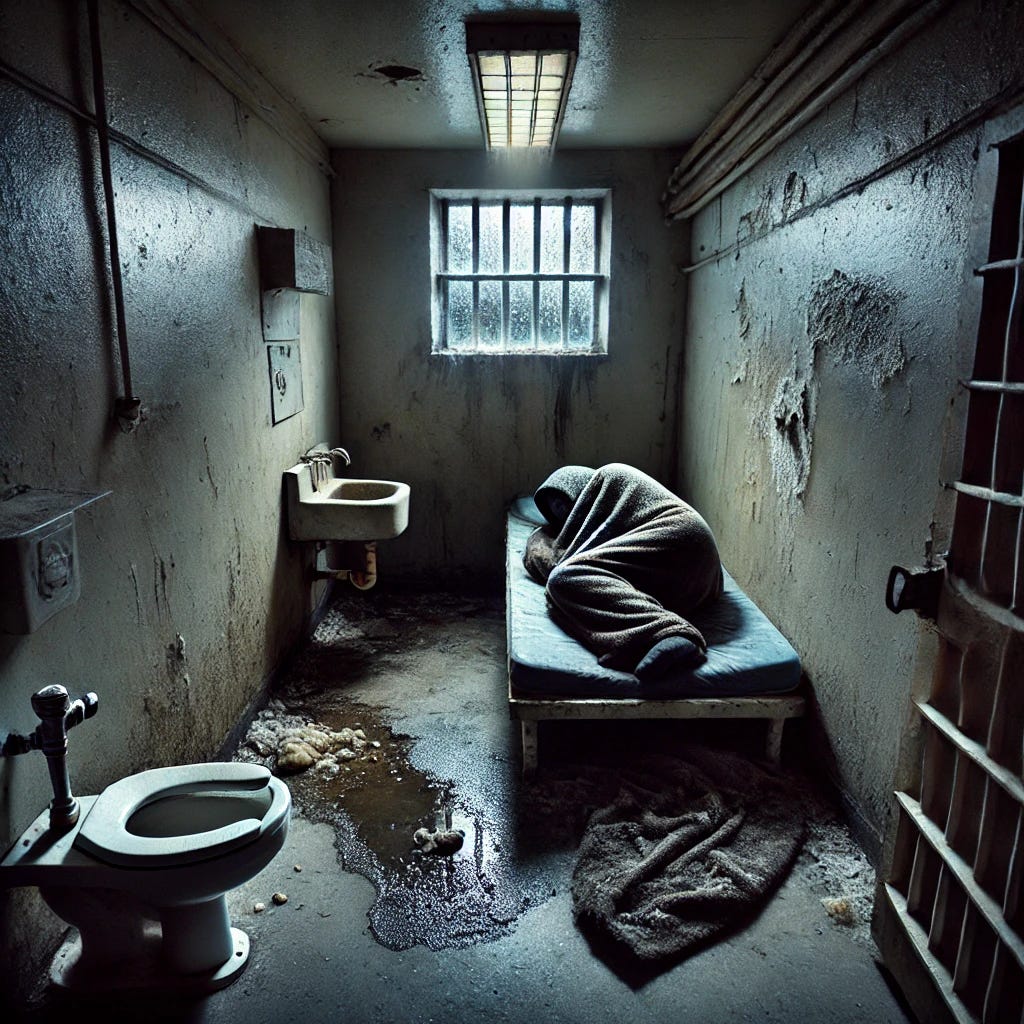
Upon arrival at Cloverhill, I did not engage. Again, I stated that this was an unlawful arrest. I was brought into a cell by up to eight prison officers and made to strip naked. I was given a crude poncho that only covered me above the navel and a small blanket that didn’t even cover my legs.
I was left in this urine and excrement-covered cell, with clots of blood around the toilet area and hard lumps of excrement stuck to the toilet and floors.
I had no shoes, socks, or underwear—just a flea-infested poncho and a rag of a blanket that was smelly and dirty.
The windows were left wide open on this freezing November night, and the cell was plunged into darkness. I sat on the bed—freezing cold, hungry, and scared.
The nightmare that had started at 2:30 p.m. was now coming alive in this cold prison cell.
I had no watch, but I estimated it was around 11:00 p.m., as court had finished around 9:30 p.m. I was very hungry and extremely thirsty.
The only water in the cell came from a tap above the toilet. I couldn’t see it, but as I felt for it, I knew it was covered in excrement and blood. Still, I had not taken water since morning, so I attempted to cup some water in my hand, rather than put my mouth to the tap—but no water came out.
I walked on the cold cement floor to the window, which was flooding the cell with icy air. I looked out and felt dreadful.
I should not be here. I should be at home.
Why was I being arrested for exercising my rights?
Assaulted. Deprived of liberty. Unlawfully detained. Falsely imprisoned.
Violated. Stripped of privacy. Lied about.
My feelings of desperation turned to anger. How dare they do this to me?
I was in court under lawful authority, prosecuting a complaint.
Why did they get involved? They had no right.
That anger soon turned to sadness as I thought of my children—how I didn’t get to see them after school, how I didn’t get to ask what they learned, how we missed our walk and ball games, how I didn’t help with homework or ask how their day was.
Then the anger came again—at the Garda, at the Judge who refused to adhere to his constitutional duty to administer justice, who flagrantly disregarded his statutory duty to deal with my lawful summonses.
This emotional cycle repeated throughout the night as I lay on a hard, cold plastic mattress, tossing and turning.
Every 15–20 minutes, a screeching clatter shattered the dense blackness as a prison officer opened the viewing hatch on the metal door, peering in at my cold body, curled up under a dirty poncho and ragged blanket.
Just as I was about to sleep, the screeching came again. The clasp of the slot sounded like a hammer hitting a steel helmet, echoing in the 10x10ft cell.
Around 1:00 a.m., I was freezing. The poncho felt like a straitjacket as I pulled my arms inside for warmth.
I squeezed my arms down the inside of the poncho and reached for the rag blanket, curling into the foetal position, trying to cover my freezing feet and legs.
Condensation covered my mouth, chin, and ran down the side of my head.
Lying on my shoulder without a pillow, my head twisted painfully—my back and neck were sore.
My entire body ached as I tried to position myself in a way that provided even minimal protection from the biting cold.
I was drifting into delirium when the hammer-on-metal returned.
Again. And again. And again.
Then the screaming started—loud wails of a man in another cell.
Footstomps outside the door sounded like a dozen men ready to charge in.
Screams. Banging. Prison officers yelling. Chaos.
And always, the hammer metal and light piercing the blackness.
By 4:00 a.m., I didn’t know if I had slept. Every time I shifted, the rags exposed my skin to the ravaging cold. I tried to curl tighter. I tried to sleep, but the noise returned, and with it, an intense awareness of the cold gnawing at my bones.
Thoughts of my family never left me. The fear, the pain, the desperation—cycling all night.
Eventually, around 6:00 a.m., a soft light entered through the window. I stood, body aching, feet numb, and saw the first light above the razor wire and high fences.
I tried to urinate, stepping barefoot onto the excrement-covered floor to reach the filthy toilet.
I lay back on the bed—exhausted, angry, desperate.
Around 7:00 a.m., an officer handed in a paper box of cornflakes with a little milk. I ate quickly but needed more milk. I knocked on the door and asked for milk and water. No response.
I lay back on the cold mattress.
Around 11:00 a.m., I believe the Governor arrived. He asked why I was there.
I explained I was exercising my rights and had been unlawfully detained.
I asked if I was being brought to the High Court, as I had made a complaint under Article 40.4.2° of the Constitution.
He said the Court had said nothing about that and told me I’d be given clothes, underwear, socks, and shoes, and moved out of the punishment cell to a more comfortable landing.
Around noon, dinner was brought in. I still had no water.
It had been over 28 hours since I’d had any water. I asked for it repeatedly but never received it.
At 1:00 p.m., a prison officer told me I could sign myself out without paying.
I signed the bond—under duress—because it was clear the judge had disregarded my Article 40.4 complaint.
I was abandoned by the State, the Judiciary, the Gardaí, the Executive, and the Legislature.
I was released from Cloverhill around 3:00 p.m. and walked to Liffey Valley, where I caught a bus back to Mullingar.
I arrived around 6:00 p.m., charged my phone, and called my family.
They had been extremely worried—they hadn’t seen or heard from me since 9:00 a.m. the day before.
Since then, the Government—through the Department of Justice and the Gardaí, who are being directed by the Office of the Director of Public Prosecutions—has attempted to prosecute me for a crime that did not occur.
Why?
Because I tried to hold a judge and Garda members accountable for breaches of the Data Protection Act 2018.
A judge received my complaint but abandoned his duty, despite being legally obligated to provide reliefs under Section 10 of the Petty Sessions (Ireland) Act 1851 and Article 34 of the Constitution to ensure access to justice.
I was trying to prosecute Garda members for offences contrary to Section 27(c) of the Criminal Justice (Corruption Offences) Act 2018 and Sections 144 & 145 of the Data Protection Act 2018.
On the 26th of November 2024, State employees violated my constitutional and statutory rights, contrary to Articles 6, 34, 35, 38, and 40 of the Constitution.
I was held in unlawful detention, contrary to Article 40.4, and I demand that these State employees be held individually accountable for actions that lay outside their statutory duty.
You are more of a man than those tyrants.
Jesua Christ Patrick.. While very hard to read Thank You for the chilling honesty and details.
This Country is run by Satan. It's just one horror show after another.
So sorry for what you went through. For sticking your neck out so we don't have to.
Fucking heartbreaking 💔
😌😡