The Phantom Authority
How the Office of the Attorney General and Its Chief State Solicitor’s Department Are Being Used Without Constitutional Authority — While Those Responsible Stand Aside

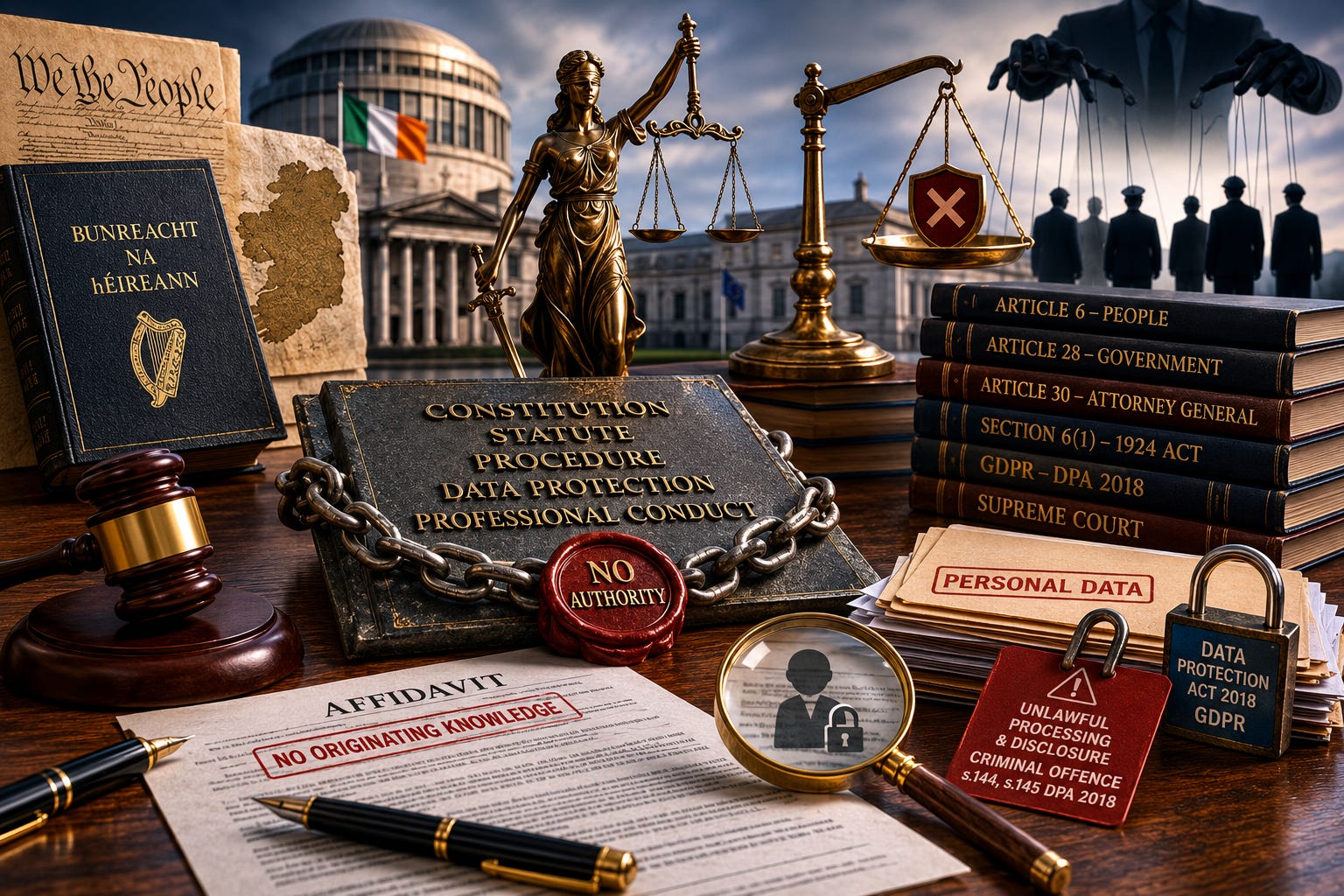
Every day, in courts across Ireland, something happens that no one questions. When a person takes a public official to court — a Garda member, a Courts Service employee, a judge, a Senator, a prison officer, even the Director of Public Prosecutions — solicitors from the Chief State Solicitor’s Department appear on the other side. They take instructions. They direct barristers. They file documents. They swear affidavits. All of it presented as normal.
It is not normal. It has no constitutional basis. It has no statutory basis. And every time it happens, a criminal offence is committed under the Data Protection Act 2018 — one that any person can prosecute in any Irish court in their own name.
Two Functions. Nothing More.
The Chief State Solicitor’s Department is not a law firm. It is a public service assigned to the Attorney General under the Ministers and Secretaries Act 1924. Under section 6(1) of that Act it has two functions and two functions only:
One — representing the Government and the public in legal proceedings for the assertion or protection of public rights.
Two — advising Ministers on matters of law.
That is the complete list. Closed. Exhaustive. No addition. No extension. No back door.
The Government is defined in Article 28 of the Constitution as the collective authority of named Ministers of State — the Taoiseach, the Tánaiste, and individual Ministers — appointed by the President and acting collectively. That is the Government. Nothing else.
A Garda member is not the Government. A Courts Service employee is not the Government. A judge is not the Government. A Senator is not the Government. A prison officer is not the Government. The Director of Public Prosecutions is not the Government. Even a Minister sued personally in their own name is not the Government in its collective capacity.
Every one of these individuals, when named as a party in any matter before any Irish court, must engage private solicitors at their own expense — like any other person. The Chief State Solicitor’s Department is not available to them. It never was.
What the CSSO Admits on Its Own Website
The CSSO’s published description on the Government’s own website at gov.ie is, on the constitutional and statutory analysis, a self-indicting document.
It describes itself as “the principal provider of solicitor services to the Attorney General and government” and refers to government departments as its clients. It has no clients. It has one principal — the Attorney General.
Its Justice Division includes a dedicated Garda Litigation Section defending An Garda Síochána in civil actions including “assault, wrongful arrest, false imprisonment, malicious prosecution, miscarriage of justice, deceit and defamation.” No statute authorises this section to exist.
Its General Litigation Section defends claims including “assault by prison officers” — using a public resource created to protect public rights, to defeat the claims of persons asserting exactly those rights.
Most damning of all, the CSSO states it “conducts criminal prosecutions in the District Court on behalf of certain Ministers.” Criminal prosecutions are the function of the Director of Public Prosecutions — positively vested in the Director under the Prosecution of Offences Act 1974. That function transferred from the Attorney General to the Director over fifty years ago. The CSSO has no authority to prosecute anyone. Yet it does — and says so publicly on the Government’s own website.
The CSSO is simultaneously defending named individuals in civil proceedings it has no authority to be in, and prosecuting in criminal proceedings where its authority was extinguished in 1974. It is operating outside its constitutional and statutory boundaries in both directions at once.
The sword created to assert and protect public rights has become a shield — used to defend members of the executive against the very persons whose public rights that sword was created to protect.
Who Is Ultimately Responsible — Ministers as Corporations Sole
This is the point that closes the accountability loop completely.
Under section 2(1) of the Ministers and Secretaries Act 1924, every Minister of State is a corporation sole — a legal person with perpetual succession, the capacity to sue and be sued in their own name, and individual personal accountability for everything that happens within their Department.
Every public official or public body within the executive has a Minister as their principal. Garda members answer to the Minister for Justice. Prison officers answer to the Minister for Justice. Courts Service staff answer to the Minister for Justice. Every agency, body, and office within the executive has a Minister at its head — a named individual, a corporation sole, personally and individually accountable.
When the CSSO is deployed to defend a Garda member, a prison officer, or a Courts Service employee in proceedings before an Irish court, the Minister who heads that Department is the corporation sole through whom the executive power that employed that individual flows. That Minister is the constitutional and statutory principal. That Minister bears individual accountability — as a corporation sole — for the acts and decisions of their Department, including for the unauthorised deployment of a public legal resource on behalf of individuals within their executive remit.
The Government exercises executive power collectively under Article 28. But Ministers exercise it individually as corporations sole within their own Departments. They cannot hide behind collective responsibility when it comes to individual departmental accountability. They are personally the corporation sole. They are personally the head of the Department. They are personally responsible.
The accountability chain is therefore direct and complete:
The people vest all powers of government in the organs of State through Article 6. The Government — the collective authority of Ministers under Article 28 — exercises executive power. Each Minister as a corporation sole heads their Department and is personally responsible for it. The people, through Dáil Éireann, hold each Minister to account under Article 28.4. And any person can hold a Minister to account directly — through Dáil Éireann, through the courts, and through private prosecution where criminal offences have been committed.
The Criminal Dimension — Any Person Can Act
Every time a named individual transmits a person’s personal data to the Chief State Solicitor’s Department for use in proceedings the Department has no authority to participate in, a criminal offence is committed. Section 38(1) of the Data Protection Act 2018 requires processing to be for a function conferred by or under an enactment or by the Constitution. No such function exists. Sections 144 and 145 of the Data Protection Act 2018 create criminal offences carrying up to five years imprisonment on conviction on indictment. Section 146 makes senior officials personally criminally liable.
These offences can be prosecuted by any person in any Irish court in their own name. No State authority needs to act first. No permission is required from anyone.
The People’s Direct Right — It Has Always Been There
The Petty Sessions (Ireland) Act 1851 — pre-independence legislation that has never been repealed — gives any person the right to prosecute summary and indictable offences in their own name and at their own suit before the courts of Ireland. Article 30.3 of the Constitution provides that prosecutions in courts above summary jurisdiction shall be in the name of the People at the suit of the Attorney General or some other person authorised in accordance with law. The 1851 Act is that law.
You do not need a solicitor. You do not need the Director of Public Prosecutions. You do not need any State authority. Any person who has had their personal data unlawfully processed by the Chief State Solicitor’s Department can prosecute those responsible — personally, directly, in their own name, in any Irish court, in the name of the People.
The enforcement of law and the prosecution of offenders is not a State monopoly. It is a People’s right. It predates the State. It is confirmed by the Constitution. And it has never been taken away.
The Accountability That Already Exists
The people of Ireland do not need to wait for the Government to act. They do not need to wait for Dáil Éireann. The constitutional and statutory framework already provides every tool needed to hold those responsible to account.
Through Dáil Éireann — which holds the Government and each Minister individually to account under Article 28.4 — the people can demand that every Minister explain on what statutory authority the Chief State Solicitor’s Department was deployed on behalf of persons within their Department.
Through the courts — where every Minister is a corporation sole capable of being sued in their own name — the people can assert their constitutional and statutory rights directly.
Through private prosecution — under the Petty Sessions (Ireland) Act 1851 and Article 30.3 — any person can prosecute the criminal offences under the Data Protection Act 2018 that have been committed against them, in their own name, in the name of the People.
The Government has allowed this practice to continue. Dáil Éireann has not acted. But the people have never needed either of them to act first. The right to enforce the law — to prosecute wrongdoing, to assert public rights, to hold power to account in the courts of Ireland — belongs to every person in Ireland directly.
It always has.
Private Prosecutions Ireland — Educating the Public on Constitutional Rights